Introduction: Every Choice Has a Cost
In a famous exchange, economist Milton Friedman was confronted by a college student about the safety of the Ford Pinto. The student criticized Ford for not making the Pinto safer, arguing that the company should have invested in additional safety measures to prevent fatalities. Friedman calmly responded that this was not just a question of safety but one of trade-offs. He pointed out that making the Pinto safer would require higher costs, and if we apply that logic universally, we could make cars completely crash-proof—but at a cost so high that very few people could afford them.
Friedman’s point was simple yet profound: there are no perfect solutions, only trade-offs. Whether in business, economics, personal life, or ethics, every decision we make comes with a price. We can increase safety, but at what cost? We can lower costs, but at what risk? We can enforce strict rules but at the expense of individual freedoms.
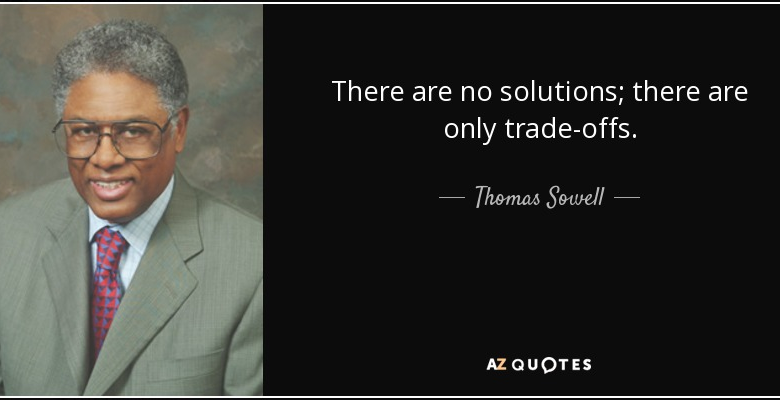
Economist Thomas Sowell articulated this reality perfectly:
“There are no solutions; there are only trade-offs.”
Yet trade-offs are not just an economic principle. They are embedded in biology, morality, leadership, and even religion. Understanding and managing trade-offs wisely is the key to making better decisions in life.
The Biology of Trade-Offs: Built into Our Existence
Trade-offs are not just something we experience in society—they are wired into our very biology. Evolutionary biologist Randolph Nesse describes this in striking detail:
“The body is a bundle of trade-offs. Everything could be better but only at a cost. Your immune system could react more strongly, but at the cost of increased tissue damage. The bones in your wrist could be thick enough that you could safely skateboard without wrist guards, but then your wrist would not rotate, and you could throw a rock only half as far. You could have an eagle’s ability to spot a mouse from a mile away, but only at the cost of eliminating color vision and peripheral vision. Your brain could have been bigger, but at the risk of death during birth. Your blood pressure could be lower at the cost of weaker, slower movement. You could be less sensitive to pain at the cost of being injured more often. Your stress system could be less responsive at the cost of coping less well with danger.”
These biological trade-offs illustrate an important principle: everything comes at a price.
This same logic applies to human decisions. More freedom often means less security. More control can mean less innovation. More firmness in leadership can mean less compassion. Since trade-offs cannot be avoided, the real question is: How do we make the right ones?
Moral vs. Practical: The Traffic Light Dilemma
In an ideal world, we might believe that every decision should be based on fairness and individual circumstances rather than rigid rules. But in practice, systems exist to manage trade-offs efficiently. Economist Mike Munger illustrates this principle with a thought experiment about a society that replaces traffic lights with negotiation.
In this system, instead of relying on red, yellow, and green lights, drivers at an intersection must negotiate with each other about who gets to cross first. A person rushing to work argues their case, another transporting a sick passenger insists they should go first, and another who simply doesn’t want to wait makes their own appeal. Only once they reach an agreement can anyone move.
At first glance, this might seem morally fair—everyone has a chance to make their case, and no one is forced to follow an impersonal rule. But in practice, it creates chaos, inefficiency, and endless conflict.
This scenario highlights a fundamental moral vs. practical trade-off:
- A system based purely on moral arguments (fairness, need-based negotiation) seems just but doesn’t scale efficiently.
- A system based purely on practical efficiency (fixed traffic rules, no negotiation) may feel impersonal but maximizes order and predictability.
The lesson? Trade-offs between fairness and efficiency are everywhere.
- In economics, free markets promote choice, but regulations are needed to prevent abuse.
- In justice systems, individualized rulings allow for nuance, but standardized laws prevent endless legal battles.
- In governance, democratic debate is valuable, but decisive action is often needed.
This is why many moral ideals must be balanced with practical limitations. Absolute fairness may seem appealing, but real-world decisions often require structured, efficient solutions to prevent stagnation and conflict.
So, when making a decision, ask:
- Am I valuing fairness over function in a way that slows progress?
- Is my desire for efficiency overriding a need for moral consideration?
- What balance between the two leads to the best real-world outcome?
Trade-offs between morality and practicality are unavoidable—but understanding them helps us make better, wiser decisions.
Defining Your Priorities: What Matters Most?
Before making a decision, the first step is to identify what is most important. Without clear priorities, trade-offs feel chaotic rather than strategic.
Take the case of Qaroon from the Quran. He was given immense wealth, but instead of using it wisely, he prioritized material success at the expense of spiritual responsibility. He ignored the warning:
[28:77] “Use the provisions bestowed upon you by GOD to seek the abode of the Hereafter, without neglecting your share in this world. Be charitable, as GOD has been charitable towards you. Do not keep on corrupting the earth. GOD does not love the corruptors.”
Qaroon’s downfall wasn’t that he was wealthy but that he failed to balance his worldly and spiritual priorities. This is a key lesson in decision-making: before you can manage trade-offs, you must first define what truly matters.
Assuming one is already aiming to make righteousness their priority, it’s useful to ask:
- Short-term vs. Long-term – Am I prioritizing immediate comfort or future success?
- Moral vs. Practical – Is efficiency more important than ethics in this situation?
- Personal vs. Collective Good – Does my decision benefit only me, or others as well?
By answering these questions, we can avoid making emotionally driven, short-sighted trade-offs that lead to regret.
Striking the Right Balance: Real-Life Trade-Offs
Once we establish our values, we must learn to balance competing demands wisely. Life is full of moments where we must weigh competing priorities, ensuring that our choices align with both our long-term well-being and our moral commitments. The Quran provides timeless guidance on how to navigate these trade-offs effectively.
Finding Balance & Avoiding Extremes
Every choice we make exists on a spectrum between too little and too much. Whether in speech, actions, or lifestyle, extremes can lead to harm. A person who is too reserved may miss out on meaningful relationships, while one who is too outspoken may push people away. A workaholic may gain financial success but at the cost of their health or family relationships, while someone too relaxed may struggle with responsibility.
The Quran warns against such imbalances using the example of wealth and charity.
[17:29] You shall not keep your hand stingily tied to your neck, nor shall you foolishly open it up, lest you end up blamed and sorry.
The Quran warns:
- Being too frugal can make us selfish and disconnected.
- Being too generous can leave us financially vulnerable.
This verse, while referring to financial habits, speaks to a wider principle: True wisdom lies in knowing the boundaries that God has set and doing our best to stay within those boundaries. Whether in speech, ambition, emotions or even personal discipline, an unbalanced approach can lead to doom. The challenge is not choosing between two extremes but learning to walk the middle path.
Avoidance: The Hidden Costs of Every Decision
Many of life’s opportunities come with apparent benefits—but every choice has an unseen cost. Some risks seem attractive because they offer immediate rewards, yet their long-term effects may be far more damaging than they appear.
The Quran illustrates this principle:
[2:219] They ask you about intoxicants and gambling: say, “In them there is a gross sin, and some benefits for the people. But their sinfulness far outweighs their benefit.” They also ask you what to give to charity: say, “The excess.” God thus clarifies the revelations for you, that you may reflect
This verse highlights a core trade-off principle: just because something has benefits does not mean it is worth the cost. In this case, the Quran warns us in another verse that gambling and intoxicants are the abominations of the devil and should be avoided, which is one of the strongest prohibitions (5:90-91). This indicates that when we do a cost-benefit analysis, we will never risk eternal damnation for any short-term benefit we think the alternative may provide us.
The same applies to any decision—career choices, relationships, investments, or lifestyle habits. Many things in life come with short-term advantages but hidden long-term consequences.
A wise decision-maker does not just ask, “What do I gain?” but also, “What am I sacrificing?” Recognizing long-term risks in seemingly beneficial choices is one of the hallmarks of wisdom.
Consult Beleivers
Seeking counsel is not a sign of weakness but a mark of wisdom and strong leadership, and it is a commandment for all believers.
[42:38] They respond to their Lord by observing the Contact Prayers (Salat). Their affairs are decided after due consultation among themselves, and from our provisions to them they give (to charity).
In daily life, the same principle applies:
- In business, a CEO must balance personal vision with the advice of advisors and employees.
- In family matters, parents must decide when to enforce rules and when to involve children in decisions.
- In personal dilemmas, individuals must discern when to trust their instincts and when to seek counsel from trusted friends or scholars.
In decision-making, there is often a trade-off between acting independently and seeking the advice of others. On one hand, self-reliance allows for quick, decisive action. Conversely, collective consultation brings different perspectives, reducing the likelihood of making poor or impulsive decisions. The following verse emphasizes the importance of balancing these two approaches through the concept of Shura (mutual consultation), where even the prophet was commanded to consult the believers in his decision-making.
[3:159] It was mercy from GOD that you became compassionate towards them. Had you been harsh and mean-hearted, they would have abandoned you. Therefore, you shall pardon them and ask forgiveness for them, and consult them. Once you make a decision, carry out your plan, and trust in GOD. GOD loves those who trust in Him.
The Quranic model suggests an optimal trade-off:
- First, consult those with wisdom and good intentions.
- Then, make a firm decision and place trust in God.
This prevents both over-analysis (which leads to inaction) and impulsivity (which leads to regret). Ultimately, the Shura principle teaches that decision-making is not about choosing between independence and consultation but about knowing when to seek counsel and when to act decisively.
When in Doubt, Err on the side of kindness
Some trade-offs are difficult to measure—so what should we do when the answer isn’t clear? An example that God gives us in the Quran is that while we maintain rigidity in our faith if we err, it is better to err on the side of kindness.
[60:4] A good example has been set for you by Abraham and those with him. They said to their people, “We disown you and the idols that you worship besides GOD. We denounce you, and you will see nothing from us except animosity and hatred until you believe in GOD ALONE.” However, a mistake was committed by Abraham when he said to his father, “I will pray for your forgiveness, but I possess no power to protect you from GOD.” “Our Lord, we trust in You, and submit to You; to You is the final destiny.
While being kind carries risks, being too harsh carries far greater risks. If we must make a mistake, let it be in the direction of mercy. Another example of this can be seen from the previous verse.
[3:159] It was mercy from GOD that you became compassionate towards them. Had you been harsh and mean-hearted, they would have abandoned you. Therefore, you shall pardon them and ask forgiveness for them, and consult them. Once you make a decision, carry out your plan, and trust in GOD. GOD loves those who trust in Him.
A leader must decide between being too harsh (which alienates followers) and being too lenient (which invites disorder). Leaders who rule with fear and control create resentment, but those who are too soft risk being ineffective. The best leaders know when to be firm and when to be compassionate. The Quran informs us that the believers in Paradise will recall:
[52:25] They will meet each other and reminisce among themselves.
[52:26] They will say, “We used to be kind and humble among our people.
[52:27] “GOD has blessed us, and has spared us the agony of ill winds.
[52:28] “We used to implore Him; He is the Most Kind, Most Merciful.”
Conclusion: Mastering the Art of Trade-Offs
Life is a constant balancing act. Every choice has a cost, and the key to success is not avoiding trade-offs but making them wisely. The real question is not whether you’ll face trade-offs—you will. The real question is: Will you make the right ones?
To make better choices, use this simple test before making a decision:
1️⃣ Compared to what? – Am I considering the tradeoffs of my decisions?
2️⃣ At what cost? – What am I sacrificing?
4️⃣ Does this align with the values established in the Quran?
5️⃣ Consult with other believers.
6️⃣ If unsure, err on the side of kindness.