You’re standing at Arafat. Sun beating down. Millions around you. Hands raised. This is it. The pinnacle of Hajj. The day Allah is closest.
But your mind goes blank.
“What should I say? I should make dua. But what dua? I planned for this moment. Now I can’t remember anything.”
You panic. Pull out your phone. Scroll through saved duas. Try to read Arabic you don’t understand. Feel disconnected.
Or worse: You brought a dua book. In Arabic. With translation you’re reading, not feeling. Mechanically reciting words. Not from the heart.
I’ve been there. My first Hajj. Standing at Arafat with a dua book. Reading Arabic phonetically. Checking translations. Missing the moment.
Until an elderly man next to me said: “Brother, put the book down. Talk to Allah. Just talk. In your language. From your heart. He understands everything.”
That changed everything.
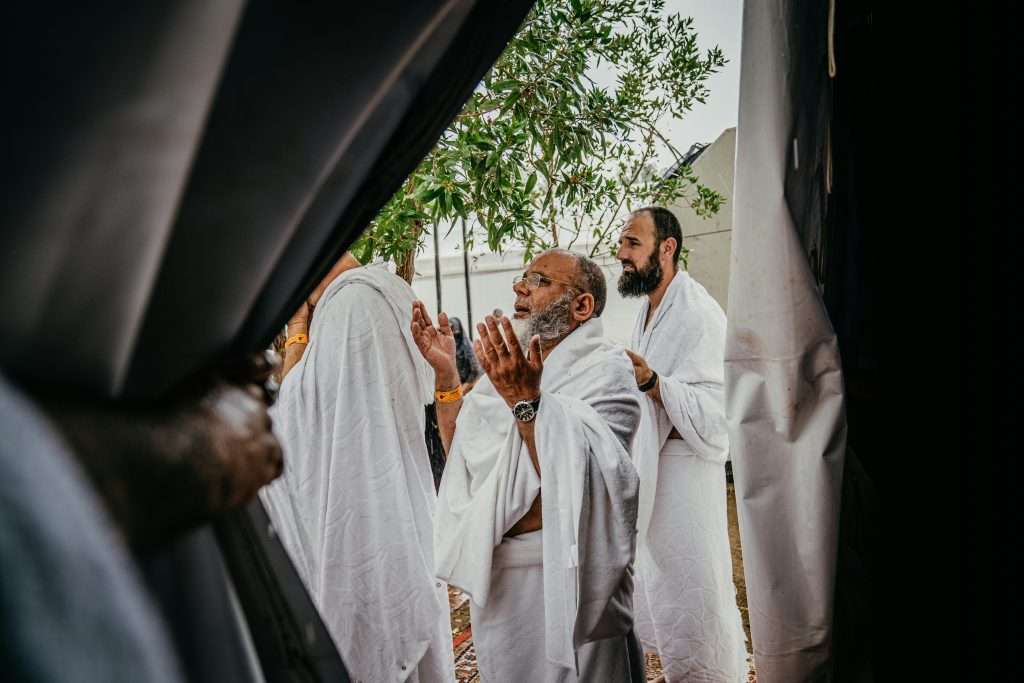
I put the book down. Raised my hands. Started talking. In English. Like I was talking to a friend. But to Allah.
“Allah, I’m sorry. For every sin. Every mistake. Please forgive me. Please fix my heart. Please guide my children…”
I cried. Real tears. From the heart. Not because of perfect Arabic. But because of sincere connection.
That’s what I’m sharing with you. Duas for Hajj. Not just Arabic words to memorize. But understanding when to make dua. What to ask for. How to connect.
Yes, I’ll give you the Arabic duas. The prophetic ones. The specific ones for each ritual.
But also permission: You can make dua in your language. From your heart. That’s valid. That’s beautiful. That’s accepted.
Let me walk you through Hajj. Each location. Each moment. The best duas to make there.
Before We Start: Understanding Dua in Hajj
The Foundation:
Allah says: “Call upon Me; I will respond to you.” (Qur’an 40:60)
The Prophet said: “Dua is worship.”
You Don’t Need Perfect Arabic:
Allah understands all languages. He knows what’s in your heart before you speak.
Memorized vs Spontaneous:
Both are good. Prophetic duas are powerful. Your own words are sincere. Do both.
The Best Dua:
The one from your heart. With need. With humility. With hope.
Dr. Ahmed told me: “Students ask: ‘Which dua is most powerful?’ I say: The one you mean. You can recite the most beautiful Arabic dua with no feeling—it’s empty. Or say ‘Ya Allah, help me’ with your whole heart—that’s powerful.”
Starting Ihram: Your First Dua of Hajj
While Hajj does not start until you get to Makkah, it starts when you enter the state of Ihram at the Miqat.
It is that time when you leave this physical world. You wear the two plain white sheets. You make niyyah and from there, your Hajj officially starts.
Dua for Entering the State of Ihram:
“Allahumma inni ureedul-hajja fa yassirhu li wa taqabbalhu minni.”
Translation:
“O Allah, I intend to perform Hajj, so make it easy for me and accept it from me.”
Immediately after this dua is made, begin reciting the talbiyah, which will become your lifelong companion henceforth.
Why This Dua Is Important:
Most Muslims are apprehensive about the Miqat. You have just dressed up in your new clothes, rules start kicking in, and it all starts becoming real.
Make use of this tension. Make your dua stronger using the apprehension, nervousness, and awe that comes from standing at the doorsteps of one of the biggest spiritual experiences in your lifetime.
What Should You Pray For at the Miqat?
Recite the above Ihram Dua and add some personal words of your own:
“O Allah, I have left my home, my family, and all that I enjoy for your sake. Accept this act of mine. Make this journey of mine an easy one. O Allah, forgive my sins before I start out.”
A Brief About Niyyah:
The niyyah for performing Hajj is made in the heart without any verbal recitation. Reciting the above mentioned Dua is a supplication for acceptance by Allah; the actual niyyah lies in the true intention of your heart.
In a conversation with Yusuf, he had said: “At the place of Miqat, I got into my Ihram attire and then it just struck me, ‘I am now really about to perform Hajj.’ At that very instant, I broke out into tears. Those were the first tears of my Hajj. Words were unnecessary at that time.”
The Talbiyah: Your Constant Dua Throughout Hajj
The Words:
“Labbayka Allahumma labbayk, labbayka la shareeka laka labbayk. Innal-hamda wan-ni’mata laka wal-mulk, la shareeka lak.”
Translation:
“Here I am, O Allah, here I am. Here I am, You have no partner, here I am. Verily all praise, grace and sovereignty belong to You. You have no partner.”
When to Say It:
From entering ihram until you stone Jamrat al-Aqabah on Eid day.
How Often:
Frequently. When you wake up. When you change location. When you see something amazing. When you feel grateful.
Men: Say it loudly (not shouting, but raised voice). Women: Say it softly.
Why It Matters:
You’re answering Allah’s call. He called you to His House. You’re saying: “I came. I’m here. At Your service.”
Fatima shared: “I said the Talbiyah so much during Hajj, it became automatic. Even weeks after returning home, I’d catch myself saying ‘Labbayk’ when I woke up. It had become part of me.”
Entering the Haram: Dua at the Sacred Mosque
The Moment:
First time you see the Ka’bah. Or entering the Haram for tawaf.
The Prophetic Dua:
“Allahumma zid hadha al-bayta tashreefan wa ta’zeeman wa takreeman wa mahabbatan, wa zid man sharrafahu wa ‘azzamahu mimman hajjahu aw i’tamarahu tashreefan wa ta’zeeman wa takreeman wa birran.”
Translation:
“O Allah, increase this House in honor, esteem, respect and reverence. And increase whoever honors and respects it—of those who perform Hajj or Umrah—in honor, esteem, respect and righteousness.”
Simpler Version:
Just say: “Allahumma aftah lee abwaba rahmatik” (O Allah, open for me the doors of Your mercy).
Or In Your Language:
“Allah, I’m finally here. At Your House. Please accept me. Please forgive me. Please make this Hajj count.”
Don’t Miss the Moment:
When you first see the Ka’bah, make dua. That’s a special moment. Duas are accepted. Don’t waste it taking selfies.
Ahmed said: “I spent my first Ka’bah sighting taking photos. Showing people I was there. I regret it. Should have made dua. Should have cried. Should have connected with Allah, not Instagram.”
During Tawaf: Circumambulating the Ka’bah
Throughout Tawaf:
No specific duas required for each circuit. You can make any dua.
Between Yemeni Corner and Black Stone:
This section has a special dua:
“Rabbana atina fid-dunya hasanah wa fil-akhirati hasanah wa qina ‘adhaban-nar.”
Translation:
“Our Lord, give us good in this world and good in the Hereafter and save us from the punishment of the Fire.”
Why This Dua:
The Prophet specifically said it in this section. It’s comprehensive: asking for both worldly and afterlife good, and protection from Fire.
General Duas During Tawaf:
- Ask for forgiveness
- Ask for Jannah
- Ask for family guidance
- Ask for health, wealth, knowledge
- Anything you need
In Any Language:
Arabic, English, Urdu, Somali, whatever. Allah understands all.
Don’t Just Speed Through:
Some people rush tawaf to finish quickly. Slow down. Each circuit is an opportunity. Make dua. Connect. Feel.
At Multazam: The Answered Prayer Spot
What Is Multazam:
The area between the Black Stone and the door of the Ka’bah. About 2 meters of wall.
The Significance:
Duas are said to be especially accepted here.
If You Can Reach It:
- Press your chest and face against it
- Spread your arms
- Make heartfelt dua
- Cry if you can
- Pour your heart out
What to Ask:
Everything. This is the place. All your sins. All your needs. All your hopes.
In Your Words:
“Allah, forgive every sin I’ve committed. The ones I remember and the ones I forgot. The public ones and the secret ones. Ya Rabb, guide my children. Protect my family. Give me a good death. Let me die with La ilaha illallah on my lips. Ya Allah, I need You. I have no one but You…”
If You Can’t Reach It:
Crowds usually prevent access. Make dua from a distance. Facing Multazam. Allah hears you regardless of proximity.
Zaynab cried telling me: “I couldn’t reach Multazam. Too crowded. I stood back and made dua from afar. I felt like I was missing out. Then I remembered: Allah is closer to me than my jugular vein. I don’t need to touch the wall. He hears me.”
At Safa and Marwah: During Sa’i
At the Top of Safa (First Stop):
Face the Ka’bah. Raise hands. Say:
“Allahu Akbar, Allahu Akbar, Allahu Akbar. La ilaha illallahu wahdahu la shareeka lah, lahul-mulku wa lahul-hamd, wa huwa ‘ala kulli shay’in qadeer. La ilaha illallahu wahdahu, anjaza wa’dahu, wa nasara ‘abdahu, wa hazamal-ahzaba wahdah.”
Translation:
“Allah is the Greatest, Allah is the Greatest, Allah is the Greatest. None has the right to be worshipped but Allah alone, Who has no partner. His is the dominion and His is the praise, and He is Able to do all things. None has the right to be worshipped but Allah alone. He fulfilled His Promise, He aided His slave, and He alone defeated the confederates.”
Then Make Personal Dua:
Raise hands. Ask for whatever you want.
Repeat Three Times:
The above dhikr and dua sequence is said three times while at the top of Safa.
At Marwah:
Same thing. The same dhikr and dua at the top of Marwah.
Between Safa and Marwah:
Any dua. Any dhikr. Any language.
The Green Lights:
Men jog between the green lights. Women walk normally. You can still make dua while moving.
Ibrahim said: “Sa’i is long. Seven trips. I ran out of memorized duas by trip 3. So I just talked. ‘Allah, help me be a better father. Help me control my anger. Help me be generous.’ Best duas I made during Hajj.”
Drinking Zamzam: The Blessed Water
The Dua:
“Allahumma inni as’aluka ‘ilman nafi’an, wa rizqan wasi’an, wa shifa’an min kulli da’.”
Translation:
“O Allah, I ask You for beneficial knowledge, abundant provision, and healing from every disease.”
Or Simpler:
The Prophet said: “Zamzam is for whatever it is drunk for.” (Sunan Ibn Majah, 3062 — Hasan)
So make intention and say: “Ya Allah, I’m drinking this for [your need: healing, knowledge, guidance, whatever].”
Every Time You Drink:
Make dua. Don’t just gulp it down. Intention matters.
In Your Language:
“Allah, I’m drinking this blessed water. Please cure my mother’s illness. Please give me beneficial knowledge. Please grant me righteous children.”
The Day of Arafat: The Most Important Dua Time
The Significance:
The Prophet said: “The best dua is the dua on the Day of Arafat.” (Sunan al-Tirmidhi, 3585 — Hasan)
This is THE day. The core of Hajj. The day Allah descends to the lowest heaven and boasts about His servants to the angels.
The Time:
From zawal (noon) until sunset. Stand. Sit. Whatever. Just be in Arafat and make dua.
The Best Dua for This Day:
“La ilaha illallahu wahdahu la shareeka lah, lahul-mulku wa lahul-hamd, wa huwa ‘ala kulli shay’in qadeer.”
Translation:
“None has the right to be worshipped but Allah alone, Who has no partner. His is the dominion and His is the praise, and He is Able to do all things.”
But Don’t Stop There:
That’s the foundation. Build on it. Add your personal duas.
What to Ask For:
- Forgiveness of all sins
- Guidance for yourself and family
- Jannah
- Protection from Hellfire
- Good death
- Provision
- Health
- Righteous spouse/children
- Knowledge
- Anything and everything
How to Make Dua:
- Face qiblah when possible
- Raise hands
- Cry if you can
- Be sincere
- Be persistent
- Don’t give up
In Your Language:
This is crucial. If Arabic isn’t your language, use your language. Allah understands. Your sincerity matters more than the language.
The Prophet’s Method:
He spent the afternoon at Arafat making dua. Raising hands. Crying. Asking. Persisting.
Don’t Waste It:
Some people sleep through Arafat. Huge mistake. This day comes once a year. Duas are accepted. Don’t sleep. Don’t chat. Make dua.
Omar shared, crying: “At Arafat, I made a list of duas. 50 items. By item 10, I couldn’t read anymore. I was crying too hard. I just kept saying: ‘Ya Allah, Ya Allah, Ya Allah’ and crying. That cry was worth more than my entire list. Sometimes you don’t need words. Just a broken heart seeking its Creator.”
At Muzdalifah: Under the Open Sky
The Time:
After leaving Arafat. Spending the night at Muzdalifah.
No Specific Duas:
Make any dua. Any dhikr.
The Atmosphere:
Millions under the stars. On the ground. In the open. It’s humbling.
What to Say:
“Alhamdulillah” (All praise to Allah) for completing Arafat.
Make dua for yourself and the ummah.
Ask for ease in the coming days.
When Stoning the Jamarat
Important:
The stones aren’t Shaytan. You’re not “killing the devil.” You’re re-enacting Ibrahim’s rejection of Shaytan’s whispers.
When Throwing:
Say: “Bismillah, Allahu Akbar” (In the name of Allah, Allah is the Greatest) with each pebble.
After Stoning Small and Middle Jamarat:
Step aside. Raise hands. Make dua facing qiblah. Take your time.
After Stoning the Large Jamarat (Jamrat al-Aqabah):
Don’t stop to make dua there. Move on. (This is for the first stoning on Eid day. For later days, you can make dua after it.)
What to Ask:
Protection from Shaytan. Strength to resist temptation. Forgiveness of sins.
General Duas for Anytime During Hajj
For Forgiveness:
“Astaghfirullah” (I seek Allah’s forgiveness) – say this constantly.
Or: “Allahumma innaka ‘afuwwun tuhibbul-‘afwa fa’fu ‘anni.” (O Allah, You are Pardoning and You love to pardon, so pardon me.)
For Parents:
“Rabbi irhamhuma kama rabbayani sagheera.” (My Lord, have mercy on them as they raised me when I was small.)
For Guidance:
“Allahumma inni as’alukal-huda wat-tuqa wal-‘afafa wal-ghina.” (O Allah, I ask You for guidance, piety, chastity and self-sufficiency.)
For Everything:
“Rabbana atina fid-dunya hasanah wa fil-akhirati hasanah wa qina ‘adhaban-nar.” (Our Lord, give us good in this world and good in the Hereafter and save us from the punishment of the Fire.)
When You See Something Amazing:
“Subhanallah” (Glory be to Allah)
When You’re Grateful:
“Alhamdulillah” (All praise to Allah)
When Things Are Hard:
“La hawla wa la quwwata illa billah.” (There is no power or strength except with Allah.)
Your Own Duas: Permission to Talk to Allah
You don’t need to stick to memorized Arabic duas only.
Make Dua In Your Language:
Allah knows all languages. He knows what’s in your heart before you speak.
Talk to Him:
Like you’d talk to the most understanding friend. But with respect and adab.
Tell Him Everything:
Your fears. Your hopes. Your sins. Your dreams. Your pain. Your gratitude.
Be Specific:
Don’t just say “guide me.” Say “guide me to be patient with my difficult mother-in-law.”
Don’t just say “give me provision.” Say “give me halal income that’s enough for my family’s needs and allows me to give charity.”
Personal Dua Examples:
“Allah, I yell at my kids. I hate that I do it. Please help me control my anger. Make me a patient parent.”
“Allah, I’m addicted to my phone. It’s taking me away from You. Away from my family. Please help me break this addiction.”
“Allah, my friend is sick. Cancer. She’s only 35. Please cure her. Please give her family strength.”
This Is Valid:
The Prophet said: “Let one of you ask his Lord for all his needs, even for a sandal strap if it breaks.” (Sunan al-Tirmidhi (3604) )
Everything. Big and small. Ask Allah.
Duas to Avoid
Don’t Ask for Harm:
To yourself or others. Don’t make dua against people out of anger.
Don’t Be Hasty:
The Prophet warned against saying: “I made dua but it wasn’t answered.”
Trust Allah’s timing. He answers in three ways:
- Gives you what you asked
- Removes an equivalent harm from you
- Saves it as reward for you in the Hereafter
Don’t Doubt:
Make dua with certainty that Allah hears and will respond. Not “if You want” doubtfully. But with full hope.
Practical Tips for Making Dua in Hajj
- Make a List Before You Go:
Write down your duas. Family members to pray for. Specific needs. Don’t trust you’ll remember in the moment.
- But Don’t Be Slave to the List:
Also speak spontaneously from the heart.
- Prioritize Arafat:
Save your deepest, most important duas for Arafat. That’s the super-charged time.
- Make Dua for Others:
Angels say “Ameen, and for you the same” when you make dua for others.
- Cry If You Can:
The Prophet said: “Nothing is dearer to Allah than two drops and two marks: A tear shed out of fear of Allah, and a drop of blood shed in Allah’s way…” [Sunan al-Tirmidhi (3623), graded Hasan by some scholars, Da’if by others.]
- Don’t Stress Perfect Arabic:
Sincerity > pronunciation.
- Keep Making Dua:
Throughout Hajj. Not just at “special” spots. Every moment is an opportunity.
Frequently Asked Questions About Duas During Hajj
Can I make dua in English (or my own language) during Hajj?
Yes — completely and without hesitation. Allah understands every language. He knows what is in your heart before you even speak. The Prophet ﷺ encouraged sincerity above all else in dua. Making a heartfelt dua in your mother tongue is valid, accepted, and often more powerful than reciting Arabic words you don’t feel. Use both: the prophetic Arabic duas for their baraka, and your own language for your personal needs.
What is the best dua to make on the Day of Arafat?
The Prophet ﷺ said: “The best dua is the dua on the Day of Arafat, and the best that I and the Prophets before me said is: La ilaha illallahu wahdahu la shareeka lah, lahul-mulku wa lahul-hamd, wa huwa ‘ala kulli shay’in qadeer.” (Sunan al-Tirmidhi, 3585 — Hasan) Repeat this dhikr as your foundation, then pour out your personal duas — forgiveness, guidance, family, health, Jannah — for the entire afternoon until sunset. Don’t save anything for later. This is the day.
Is there a specific dua for each circuit of tawaf?
No. The Prophet ﷺ did not assign a specific dua to each of the seven circuits. You are free to make any dua, any dhikr, in any language throughout tawaf. The one exception is the stretch between the Yemeni Corner and the Black Stone, where it is Sunnah to say: “Rabbana atina fid-dunya hasanah wa fil-akhirati hasanah wa qina ‘adhaban-nar.” Use the rest of tawaf to ask for whatever is on your heart.
What if I can’t reach Multazam because of the crowds?
Make dua from wherever you are. Face the direction of Multazam, raise your hands, and pour your heart out. Allah is not limited by distance or proximity to a wall. As one of the pilgrims in this article put it: “Allah is closer to me than my jugular vein. I don’t need to touch the wall. He hears me.” The acceptance of dua at Multazam is tied to sincerity, not physical contact.
How do I make dua for Zamzam water?
The Prophet ﷺ said: “The water of Zamzam is for whatever it is drunk for.” (Sunan Ibn Majah, 3062 — Hasan) Before you drink, make your intention clearly in your heart and, if you wish, verbally: “Ya Allah, I am drinking this for [your specific need — healing, knowledge, provision, a righteous child].” Then drink facing the qiblah, in three breaths, without rushing. Every sip is an opportunity for a dua.
What happens if my duas don’t seem to be answered?
The Prophet ﷺ warned against becoming hasty and saying “I made dua but it was not answered.” Allah responds to every sincere dua in one of three ways: He gives you what you asked for; He removes an equivalent harm from your life that you were unaware of; or He saves it as a reward for you on the Day of Judgment — which may be the greatest gift of the three. Trust His timing. Trust His wisdom. Your dua at His House was never ignored.
Conclusion: Talk to Your Lord
You came all this way. Spent all that money. Left your home. Put on ihram.
Don’t leave without talking to Allah. Really talking.
Not just reading pre-written duas from a book (though those are good too).
But pouring your heart out. In your language. About your real problems. Your real sins. Your real needs.
That elderly man at Arafat was right. Put the book down sometimes. Raise your hands. Talk.
“Allah, I’m here. At Your House. Please don’t send me back empty-handed. Please forgive me. Please accept me. Please change me.”
That’s the dua that matters. The dua from a sincere, broken, hopeful heart.
The duas I shared? Use them. They’re from Sunnah. They’re powerful.
But also give yourself permission to just be yourself with Allah. To cry. To ask. To hope.
May Allah accept your duas. May He accept your Hajj. May you return sinless, forgiven, transformed.
And may your duas at His House be answered in ways better than you imagined.
Ameen.